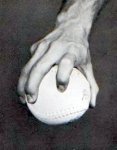
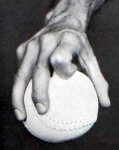
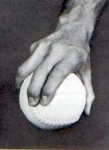
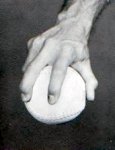
<a href="http://share.ovi.com/media/ratwod.softball/ratwod.12518"><img src="http://media.share.ovi.com/m1/lt/2990/657e49f2b5384a80b857615f8e7f1dc5.jpg" border="0" title="drop-grip - Share on Ovi" alt="drop-grip - Share on Ovi" width="280" height="125" /></a>
(Click on picture to enlarge)
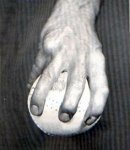
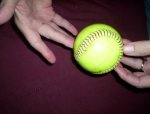
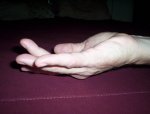
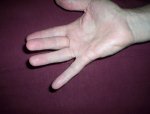
This is Val Wood's grip used for a over-the-top drop. She used the same grip for a curve. The grip is similar to a two-finger fastball grip with the fingers laying diagonally across the seams. Note that the ring finger is touching the seam.
<a href="http://share.ovi.com/media/ratwod.softball/ratwod.12519"><img src="http://media.share.ovi.com/m1/lt/2990/7930c0d0eb65439fb2a80f3c195dd377.jpg" border="0" title="fastball-grip - Share on Ovi" alt="fastball-grip - Share on Ovi" width="280" height="111" /></a>
(Click on picture to enlarge.)
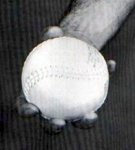
Basic two finger fastball grip. Val has small hands, so she really has to stretch to use two fingers. The disadvantage of a two-finger grip with small hands is that the ball slips out of the hand easily. The advantage is that the ball slips out of the hand easily.
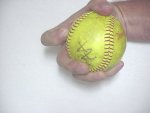
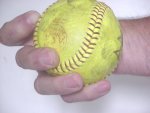
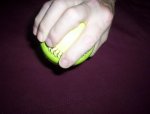
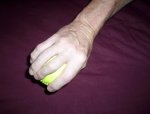
The first image shows the "finger tip" rise ball grip. The second image shows the "knuckle" rise ball grip. The third image is the "fingers together" rise ball grip. The final image shows the "fingers apart" rise ball grip.
It is NOT necessary to bend a finger over to achieve a knuckleball that will dance a jig.
All that IS required is for the ball to leave the hand with no spin, or very very little.
I hope these pictures do it justice. This is how I learned, threw and taught a knuckleball. I think most other knuckles are thrown at a slow or off-speed. This one will dance at fast, medium and slow.
I would usually throw it as fast as I could, my catchers hated it but the batters hated it even more.
In the pictures, please note the end of the middle finger is placed under the edge of the ring finger. The ring finger should cover about 1/3 of the end of the middle finger.
The horseshoe is upside down and the middle finger on the seam just to the right side of bottom of the horseshoe. The bottom of the horseshoe is at the top remember.
On releasing the ball from the hand; The hand opens wide and the last thing to touch the ball as it leaves is the middle finger. The middle finger will be raised up just slightly above the other four. The palm should be flat facing upwards with just a slight tip downwards on the thumb side, thumb just a little lower than the pinky. That should put the middle finger pointing about halfway up the backstop.
There is NO follow through here. The hand stops with the other three fingers pointing straight at the catcher. As soon as the ball leaves the hand, stop the hand.
RH pitcher to RH batter; Once practiced this pitch will have a tendency to dance and go down and in, sometimes very quickly. It can also break SHARPLY in whatever direction the wind might be blowing, even the slightest breeze.
Practice it at different speeds and see what it does, indoors and outdoors.
This pitch requires fingertip finesse. You have to be thinking about your middle finger while you throw it.
If the other team sees the grip, they will probably read it as a drop or fastball, no noticeable bend in the midlle finger like most knuckles have. As the hand opens you give the ball just the teeniest tinyest push with ONLY the middle finger. That will stop the ball from spinning.